
Your prints come out the way you validated them.
Designers and product creators increasingly look for a print partner running pure Bambu Lab hardware, and for good reason. If you prototyped and tested a model in Bambu Studio, printing it anywhere else means re-interpreting your settings on different motion systems, different extruders, and different firmware.
We remove that gap. Same slicer, same ecosystem, same hardware behaviour as the machine on your own desk, just a lot more of them. The result is that the part you signed off in your workshop is the part that ships to your customer, at a volume and reliability a single machine cannot reach.
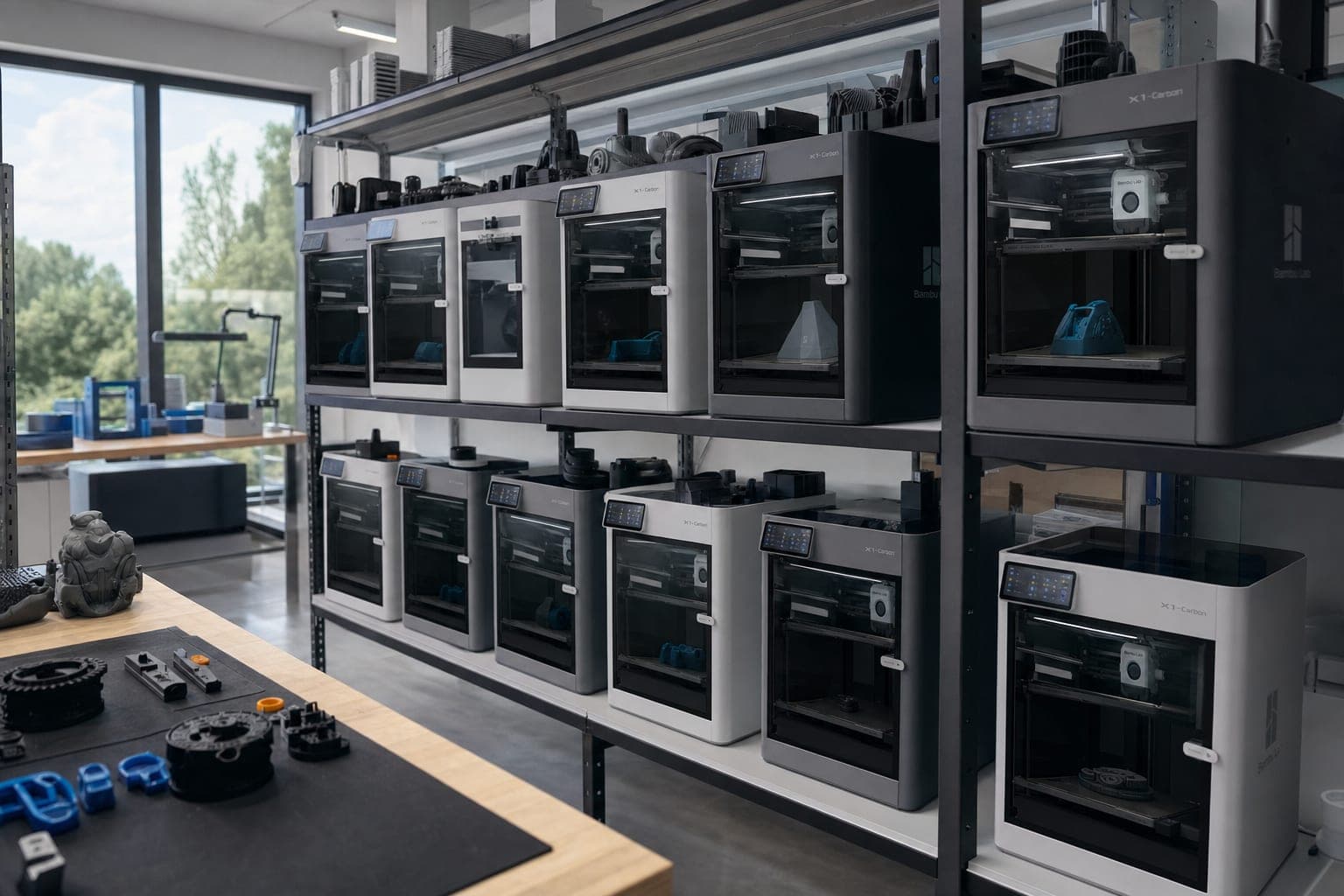
From fast colour work to carbon-fibre engineering parts.
The fleet spans the full Bambu Lab range, from the open-frame A1 series through the enclosed P1S to the dual-nozzle H2D. Each machine earns its place by being the right tool for a different kind of job.
Fast, near-silent PLA and PETG. Up to four colours on small, detailed parts.
Larger multi-colour PLA and PETG work and vibrant display pieces.
Enclosed CoreXY for ABS and ASA, AMS multi-colour, the backbone of volume runs.
Dual nozzle, 350°C hotend, carbon and glass-fibre reinforced filament, soluble or breakaway support on the second nozzle.
Why we run a farm, not a printer.
A farm is not just more machines. It is what lets us hold a deadline, keep a 500-unit run consistent, and recover when hardware misbehaves, the things that separate a hobby setup from a production partner.
The right machine, not just one machine
Colour work runs on the A1 series and AMS lite. Enclosed engineering parts run on the P1S and H2D. Abrasive carbon and glass-fibre filament only ever touches the hardened, high-temperature H2D. We match your part to the machine built for it.
Parallel capacity and built-in redundancy
A large run is split across multiple plates printing at the same time, so volume does not mean a long wait. And because no single machine carries your whole order, one printer going down never stalls a deadline.
One ecosystem, repeatable output
Every machine is Bambu Lab, sliced in Bambu Studio, with RFID-synced filament and per-machine flow and pressure-advance calibration. Part number one matches part number five hundred.
Entirely in-house, in the UK
Every print is produced in our own Huddersfield workshop. We do not farm work out to anonymous overseas operators. The fleet, the calibration, and the quality control are all ours.
Send a sliced 3MF and we keep as close to your settings as possible.
This is the part most print services will not offer. If you have dialled in a profile you trust, we honour it rather than overriding it with ours. Where we do adjust, it is only ever for printability, never to cut our own time or material cost. Your quality intent comes first.
- Mesh, the raw shape of the part
- No layer height, walls, or infill
- No temperatures or flow
- No plate layout or colour assignment
- Mesh, the raw shape of the part
- Layer height, walls, infill, supports
- Temperatures, flow, orientation
- Plate layout and colour assignment
Slice it in Bambu Studio
Set your layer height, walls, infill, supports, orientation, temperatures, and flow exactly as you want them, then export a .3mf. STL carries only geometry; a 3MF carries your full print profile, plate layout, and colour assignments.
We validate before we print
We check the mesh, plate, and toolpath for collisions, open edges, and anything that will not print cleanly. We never silently change your settings.
We run it as authored
On matching Bambu hardware, your profile prints as you set it. If your profile targets a printer, nozzle, or material outside our fleet, we map it to the closest machine we run and flag every change with you before anything prints.
Quality control and dispatch
First-layer and dimensional checks before packing. Plain or branded packaging, palletised despatch, and white-label fulfilment on request.
No tuned profile of your own? That is fine. Send an STL and we slice it on our own calibrated farm profiles. Either way you get the same fleet and the same quality control.
What we print with.
Production filament on the shelf, with carbon-fibre reinforced and high-temperature engineering materials reserved for the H2D. Colour availability is confirmed at quote stage, and Pantone matching is available for brand runs.
Rigid, accurate, cost-effective. Display pieces, prototypes, and decorative items.
Strong with good layer adhesion. Functional parts and light enclosures.
Rubber-like and impact resistant. Grips, gaskets, and wearable parts.
Weather and UV stable. Outdoor parts and anything exposed to heat or sun.
Carbon-fibre reinforced engineering filament. Stiff, strong, dimensionally stable.
Polycarbonate for high-temperature, high-strength functional parts.
Colour mixing is arriving in Bambu Studio, blending filament to produce new shades and gradients from fewer spools. It widens what we can offer on multi-colour work, and we are bringing it into the farm as it matures.
Fast, because the capacity is already there.
A farm means we rarely queue. Standard runs dispatch in a few days, and when a deadline is tight we can turn work around in as little as 24 hours, subject to current capacity and material on the shelf.
3 to 5 days
From order confirmation to dispatch. Includes print, QC, and packaging.
Up to 24 hours
For urgent work, subject to current capacity and material on the shelf. Tell us your deadline at enquiry stage and we will confirm the same working day.
The unglamorous work that makes prints repeatable.
Good output is not luck. It is calibration, dry filament, the right nozzle, and checking the first layer every time.
Per-machine calibration
Flow and pressure advance are tuned on each printer, not assumed. It is why output stays consistent across the fleet and across reprints months apart.
Filament handling and drying
Hygroscopic materials like PA, PETG, and TPU are dried before printing. Damp filament is the hidden cause of stringing, weak layers, and surface defects, so we control for it.
Nozzle sizing to suit the part
0.2 mm for fine detail, 0.4 mm as the all-rounder, 0.6 and 0.8 mm for speed and strength on larger parts. We pick the nozzle that fits the job, not whatever is loaded.
Hardened nozzles for abrasives
Carbon and glass-fibre filament wears out standard brass nozzles fast. The H2D runs hardened, high-temperature nozzles built for it, so reinforced parts print true.
Send a file, or get an instant estimate.
Use our standard Print Only service to upload a file and get a written quote within one business day, or run a model through Quick Quote for a live slicer estimate in seconds. Repeat orders and trade accounts welcome.